
The Complete A-Frame & Sandwich Board Sign FAQ
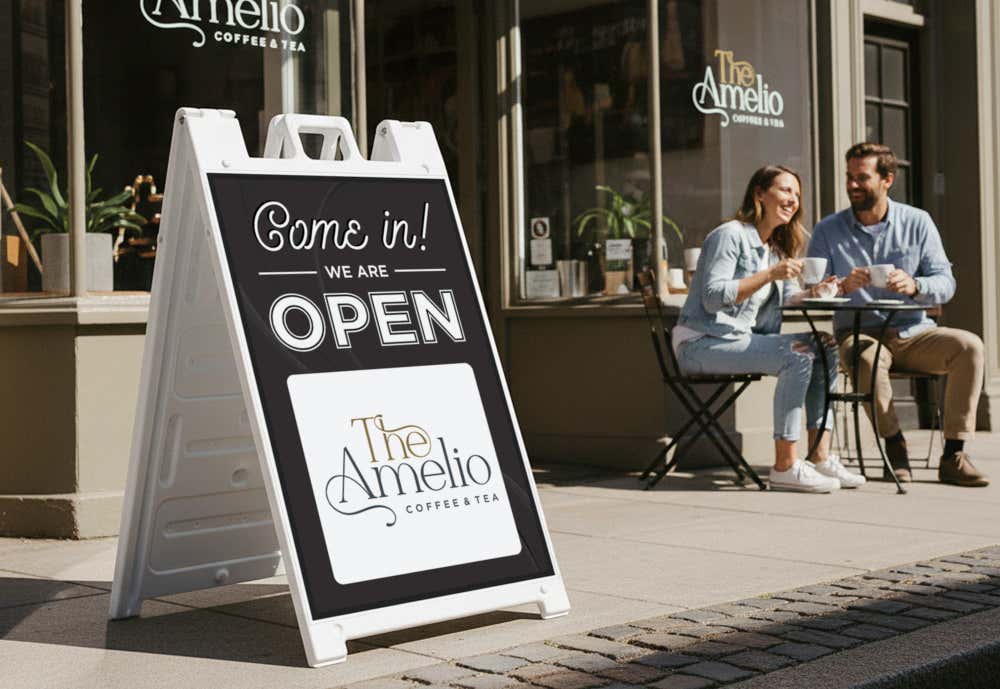
An A-frame sign, also called a sandwich board sign or sidewalk sign, is one of the most effective and affordable ways to drive foot traffic to your business. Whether you're a restaurant promoting daily specials, a boutique announcing a sale, or a service business pointing customers to your door, a well-placed A-frame sign stops people in their tracks.
At Custom Signs, we've helped thousands of businesses across the country find the right sandwich board for their space. In this guide, we answer the most common questions we hear, from what exactly a sandwich board is to how to care for one so it lasts for years.
In this guide:
- What is a sandwich board sign?
- A-frame vs. sandwich board — what's the difference?
- Are sidewalk signs allowed everywhere?
- How heavy should a sandwich board be?
- Can you leave A-frame signs outside overnight?
- How do I care for my sandwich board sign?
- What size should a sandwich board sign be?
- What material are sandwich board inserts made of?
- Can you put different designs on each side?
- How long does a sandwich board sign last

Q1 - What is a sandwich board sign?
A sandwich board sign is a freestanding, two-sided display sign designed to sit on a sidewalk or in front of a storefront to attract passing foot traffic. The name comes from the original design, two boards hinged at the top, splayed at the bottom into an "A" shape, like a sandwich around a person's body.
Today's sandwich board signs are purpose-built for businesses. They typically feature a lightweight but durable frame, often aluminum or steel, and two interchangeable sign panels, one on each side. This double-sided design means your message is visible from both directions, making them especially effective on busy pedestrian streets.
Common uses include menu displays for restaurants, sale announcements for retail shops, directional signs for offices or events, and daily specials boards for cafes and bars. Because the inserts are easy to swap out, sandwich board signs are a highly flexible, reusable investment.
Quick tip: You may also see them called A-frame signs, sidewalk signs, A-boards, or pavement signs; they all refer to the same type of product.
Q2 - What is the difference between an A-frame and a sandwich board?
The terms "A-frame" and "sandwich board" are most often used to mean the same thing, and that's perfectly fine. The A-frame is the folding structure itself that holds two sign inserts in place.
Strictly speaking, a sandwich board refers to the complete unit: the A-frame hardware plus both sign inserts on either side. But in everyday use, customers, designers, and sign shops treat the terms as interchangeable.
Bottom line: If you see either term while shopping, you're looking at the same product family. Just confirm the sign comes with inserts included; some listings sell the frame only.

Q3 - Are sidewalk signs allowed everywhere?
Not always, and it's worth checking before you set one out. Rules around sandwich board signs vary significantly by city, county, and even zoning district. Many municipalities require businesses to obtain a sign permit before placing an A-frame on the sidewalk, and some areas restrict them to private property only, prohibiting placement in the public right-of-way entirely.
Beyond permits, ADA accessibility requirements apply in most jurisdictions. Federal guidelines require that sidewalks maintain a clear pedestrian path, typically a minimum of 36 inches of unobstructed width. Your sign cannot block wheelchair access, impede pedestrian flow, or create a trip hazard. Signs also generally need to stay within your business's frontage and be removed at the close of each business day.
Some cities have additional rules around sign size, display hours, illumination, and color requirements. Cities like Portland enforce permit requirements strictly, with fines for non-compliant signs.
Before you display: Contact your local zoning or code enforcement office to confirm what's required in your area. A quick call can save you from a fine. Most permits, where required, are simple and inexpensive to obtain.
Q4 - How heavy should a sandwich board be?
Sandwich board signs typically weigh around 18 pounds, light enough to move in and out each day but sturdy enough to stay put on a calm sidewalk.
For windier locations, most A-frames include a ballast tray at the base. Adding about 5 pounds of sand or water to each side significantly improves stability without making the sign hard to move. Sand is generally preferred over water for permanent ballast since it won't evaporate or freeze.
Stability tip: If your sign is in a high-traffic or breezy spot, opt for sand ballast and position the sign parallel to the direction of foot traffic; this reduces the surface area catching wind.

Q5 - Can you leave A-frame signs outside overnight?
Technically yes, but it's not something we recommend for everyday use. Here at Custom Signs, we put our own sandwich board signs through a month-long outdoor test to verify quality, and they held up well.
For typical storefronts and sidewalk setups, though, bringing your sign in each night is the smarter move. A-frames are designed to be portable, which also makes them easy to move or easy for someone else to move. Taking the sign inside reduces the risk of theft or misplacement, and proper nightly storage will extend the life of your sign considerably.
Pro tip: Think of it like patio furniture, capable of handling a night out, but happier indoors when not working.
Q6 - How do I care for my sandwich board sign?
A little routine goes a long way. When you bring your sign in each evening, give it a quick wipe-down with a microfiber cloth to remove dust, moisture, and grime before it builds up. It takes less than a minute and keeps the frame and inserts looking fresh.
Bring it in during extreme weather. Wind, heavy rain, and hail can damage inserts and stress the frame hinges. Our signs survived multiple Florida storms without a scratch during testing, but we don't recommend making that a habit.
Limit direct sunlight exposure. UV rays cause fading and sun bleaching over time. When you can, position your sign in shade or bring it inside during peak sun hours.
Add a UV protective laminate. If your sign lives in a sunny location, laminating the inserts is a smart investment. Laminate shields against UV light and makes the surface easier to clean, especially valuable here in Florida, where the sun is relentless.
Florida tested: Our A-frame signs were left outside through multiple storms without a scratch, but for your sign's longevity, consistent indoor storage is always the better call.
View this post on Instagram
A post shared by Custom Signs (@customsignsco)
Q7 - What size should a sandwich board sign be?
Size matters more than most people realize: too small and your sign gets overlooked; too large and it may violate local placement rules or simply be hard to store.
The most popular and versatile size is a 24" × 36" insert, which is the standard we use here at Custom Signs. At that size, text and graphics are easy to read from across a sidewalk or parking lot, making it the right choice for most storefronts, restaurants, and retail locations. It's large enough to command attention without being unwieldy.
The frame itself is slightly larger than the insert to hold it securely in place. Our A-frame measures 25" wide × 45" tall when standing, a footprint that fits comfortably on most sidewalks while staying well within the 36-inch ADA clearance requirement when placed correctly.
Insert size:24" × 36"
Frame size:25" × 45"
Design tip: With a 24×36 insert, keep your headline to 3–5 words in large type. Passersby make a split-second decision; less is always more.

Q8 - What material are sandwich board sign inserts made of?
The insert is the printed panel that slides into your A-frame, and the material it's made from determines how long your sign looks great outdoors.
At Custom Signs, our inserts are printed on 4mm corrugated plastic (also called coroplast). It's the same ribbed, lightweight plastic you've likely seen used for real estate signs and political yard signs, and for good reason. Corrugated plastic is waterproof, UV-resistant, lightweight, and far more durable than paper or foam board alternatives.
The 4mm thickness hits the sweet spot for sandwich board use: rigid enough to hold its shape in the frame and resist wind flex, but light enough that swapping inserts out is quick and easy. Some cheaper signs use thinner 3mm panels, which can bow and warp over time, especially in heat.
Why it matters: A great-looking print on a flimsy insert still looks cheap. Quality coroplast keeps colors vivid and edges crisp through regular outdoor use, sun, and rain.
Q9 - Can you put different designs on each side of an A-frame sign?
Yes, and it's one of the best features of a sandwich board sign. Because each side holds a completely independent insert panel, you can run two entirely different designs at the same time.
This is useful in more ways than people expect. A restaurant might show the lunch menu on one side and happy hour specials on the other. A retailer could feature a sale on one side and directions to the entrance on the other. Some businesses even use the two sides to target foot traffic coming from opposite directions with different messages.
At Custom Signs, both sides are included as standard, so there's no extra charge for printing two unique designs. Just upload your artwork for each side when you order.
Pro move: Use one side for your offer and the other for a QR code linking to your menu, booking page, or online store. Double the real estate, double the opportunity.
Q10 - How long does a sandwich board sign last?
A well-made sandwich board sign, used and stored properly, should last several years. The frame itself, typically steel or aluminum, is the most durable component and can last a decade or more with basic care.
The inserts have a shorter lifespan since they're exposed to the elements daily, but our 4mm corrugated plastic panels hold up well under real-world conditions. During testing here at Custom Signs, we kept a sign outside in Florida for over a month through heat, humidity, and multiple storms, and it came through without a scratch.
The biggest factors that shorten insert life are prolonged direct sunlight (which causes fading and bleaching) and leaving the sign out overnight repeatedly. Follow the care habits in Q6 above, and your inserts will stay sharp-looking far longer. When they do eventually show wear, swapping in a fresh printed insert is quick and inexpensive; no need to replace the whole sign.
Bottom line: Think of the frame as a long-term investment and the inserts as a consumable you refresh as needed. It's a much more cost-effective model than replacing an entire sign every time your promotion changes.
Ready to find your perfect sidewalk sign?
Shop sandwich board signs at CustomSigns.com ↗Learn more about our A-frame signs in this video: